Showing posts with label S. Alex Martin. Show all posts

Friday, September 6, 2013

"Hooking the Reader through World Building," with S. Alex Martin

S. Alex Martin is an author of young adult soft science-fiction, a blogger of writing tips and tricks, and a rising college senior in Pittsburgh. He's written and self-published three hard sci-fi books since 2004, and is finishing the fourth draft of "Embassy," the novel he hopes will become his debut in traditional publishing. You can follow him on his websiteTwitterPinterest, and Facebook.


Welcome to my first post in our newest series, "Hooking the Reader through World Building." Today I'm going to talk about some key elements to your stories' worlds and environments. So stick around and take a few notes!

#1. THE WORLD SHOULD REFLECT THE STORY.

This is the most essential part of world building. You aren't going to set a fantasy novel on a spaceship with laser cannons. You're going to have mountains and vistas and magic and dragons and ugly creatures and dark forests and castles and straw towns. Imagine if "Lord of the Rings" happened in the "Star Wars" universe.

Another aspect to consider is what can the setting do for the story? Think of your main character's goals. Is he trying to run away from something? Is there another world that is better than the one he lives in? How will he get there? Who will he meet along the way? What obstacles will he face?

Incorporate all of these elements into the setting. Marshes, mountains, rivers, graves, deserts, outer space, lack of air in a spaceship, traffic on the interstate...heck, even a flight delay. Make it work for your world.

#2. USE CONCRETE DESCRIPTIONS.

If you want your reader to visualize your world, don't start throwing abstract imagery around and assume your colorful words will paint a picture.

No. Just don't. Please. The key to effective imagery is this: simplicity. Use the words that get the job done -- and nothing more. Don't start bombarding your story with similes and metaphors. I beg you. Sure, it's okay to use one or two. They won't hurt anyone. But if you compare every river to a winding snake, or every building to an elegant monument....it's going to get old FAST. Just say it as it is, and stop.

Then sprinkle on some grander visuals -- but limit them.

As I like to say: "Don't paint. Build." It's fine to paint the main character's personal views to help emphasize what they think, but nature and cities are nature and cities. Make it easy for your reader to see the world by keeping your descriptions SIMPLE. Or, as the heading says, concrete.

#3. KEEP DISTANCES AND TERRAIN REALISTIC.

Who here can trek 1,000 miles in four days on foot? Anybody? No? Well that's a good sign. Now, have you ever read a book where characters walk impossible distances in no time at all? Or, say, cross a city in a few short minutes?

As authors, we need to be wary about relativity. Space and time play a HUGE part in world building. Unless your characters have teleports, or use magic to cross the country, prepare to dig in and figure out a way to fill in the journey.

Leave us with the sense that the characters did more than skip across the city, arm in arm a big smiles pasted on their faces. No, show us some of the jay-walking, brake lights, stop signals, crowded sidewalks, and beeping horns. The tug of the current in the river, the chill of the icy water on our skin, the weight of our waterlogged clothes, the short breaths we make as we try to stay afloat.

This stuff happens in real life, so why would it be so easy in the story?

----------------------------------------------------------

That concludes this week's post! Hope you're able to use these tips to develop your story worlds better and pull your readers into the next level of the story. If you liked what you saw, please share this post and leave a comment below!

Until next time,
S. Alex Martin

Friday, August 23, 2013

Character Essentials: "Hooking the Reader through Character Building, Part 4" with S. Alex Martin

S. Alex Martin is an author of young adult soft science-fiction, a blogger of writing tips and tricks, and a rising college senior in Pittsburgh. He's written and self-published three hard sci-fi books since 2004, and is finishing the fourth draft of "Embassy," the novel he hopes will become his debut in traditional publishing. You can follow him on his websiteTwitterPinterest, and Facebook.


Hey everyone, welcome to my last post in this series. Hope you enjoyed Brian's post last week!

Today's post is a bit shorter because I'm going back to college tomorrow, so I've been packing and shopping--all while finishing the fourth draft of my novel, Embassy. Yeah. I've been rushing around all week.

Anyway, I want to look at two specific ways to show how to develop characters: involvement their world, and how they deal with events.

#1. INVOLVEMENT IN THEIR WORLD.

Characters need roles. When the story opens, readers want to know who the characters are. What do they do? What events have shaped them? If you show your characters place in society, the reader will better understand what journey the character is going on and why they are going on it.

This is why it's so crucial to understand character back stories. Some people like to list hobbies and education and favorite foods and colors, etc, before they begin writing the story. Other people (like me) let the characters shape themselves as they write.

Here are examples of a character's  involvement  in different novels:

Robert Langdon is a professor of religious symbology at Harvard University, and is called upon to investigate religious-related happenings in the Vatican and other cities. ("Angels and Demons," by Dan Brown)

Hazel Lancaster is a cancer child who must cope with death, and falls in love with a boy who lost his leg to cancer. ("The Fault in Our Stars," by John Green)

Beatrice Prior is a sixteen year old girl who lives in a world divided into five factions, and the day has come for her to make a choice: stay with her family, or join a new faction. ("Divergent," by Veronica Roth)

You can see how these characters are involved in a world that directly relates to the story. Use that to shape your characters, and then present events that will progress the characters' changes.

#2. DEALING WITH EVENTS.

Characters need to react to their worlds. This means  there need to be events that force the characters to make decisions--and sometimes they won't make the right ones. When necessary, complicate their lives. Make bad things happen. Make good things happen. But let your characters show their true selves in the choices they make, and maybe show how they change through the story.

We'll see three major ways characters act in their worlds: some will be active and seek out challenges. Others will be passive and let things progress as they are. Still, others will be reactive and make choices only as events happen.

Let's take the examples I used above and show how the characters react to the events in their stories. Keep in mind some stories have a mix of the three ways characters act:

ACTIVE: Robert Langdon must track down and stop an Illuminati plot to attack the Catholic Church after the death of the Pope. He must ACT and figure out where the Illuminati will strike, how they'll strike, and do so before the antimatter bomb destroys the Vatican and kills millions of people. (Angels and Demons)

PASSIVE: Hazel Lancaster can't really do much for her condition. She goes to support group, thinks about death a lot, and pretty much lives knowing she will die one day. When she meets Augustus Waters, they both have their jokes and travel together using his "Wish." But their reality always looms over them. (The Fault in Our Stars)

REACTIVE: Beatrice Prior joins a new faction and must react to her world and circumstances. Fights, fear tests, and a dark plot are ever-present. All of this is thrown at her and she must adapt to the situations. (Divergent)

--------------------------------------------

Well, that's my last post in this series! Brian will be back next week with the final installment of "Hooking the Reader through Character Building."

Have questions? Need clarification? Comment below and I'll reply!

Until next time,
S. Alex Martin

Friday, August 9, 2013

Character Essentials: "Hooking the Reader through Character Building, Part Two" with S. Alex Martin


S. Alex Martin is an author of young adult soft science-fiction, a blogger of writing tips and tricks, and a rising college senior in Pittsburgh. He's written and self-published three hard sci-fi books since 2004, and is finishing the fourth draft of "Embassy," the novel he hopes will become his debut in traditional publishing. You can follow him on his website, Twitter, Pinterest, and Facebook.


Hello everyone! This is my first post as a YAWA admin and my first post in the series Brian and I are co-hosting: Hooking the Reader through Character Building.

You'll find that one of the hardest parts in the writing process is character development. The story only happens if the characters matter and fit into their unique roles. If you can toss around the characters and still have the same story, stop. Because you have a BIG problem.

Characters should feel like people. The real, living and breathing people who make life interesting (because clearly there are other kinds). Today I'm going to show you how to develop characters without whom the story can't go on.


#1. GIVE EVERY CHARACTER A GOAL.

And I mean EVERY character. If someone comes into the story and doesn't leave for a while, they need something to do. Don't just put them in because it's convenient, or because you think you need to hype up the pace. Those are just bad excuses that leave similarly-bad tastes in your readers' mouths.

Your main character needs a goal. State that as early in the story as possible. What journey are we--the reader--about to embark on? Will this journey take us to places we've never dreamed of? Will we meet people who amaze or scare us? Or are we gonna trudge around in our boots, stuck in the mud half the time, listening to an old beggar who just annoys us?

Hopefully we get the former, 'cause I don't have the time--or the money, for that matter--to hang out with some old guy in a robe. Unless he's Obi-Wan Kenobi. Then we'll see.

Also think of your minor characters. Yes, they'll have roles. But don't make them cookie-cutter images of every cliche out there. Make them unique individuals who have lives, live those lives, and are AFFECTED by those lives. Sure, the best friend seems happy around the main character, but at his house he gets into heated argues with his parents, which leads to his rebellious behavior and ultimate arrest. Something like that.

If you can create a complicated character whose life doesn't revolve around the main character, you're doing you book--and your credibility--justice.


#2. DEVELOP CHARACTER RELATIONSHIPS.

*sigh* No, I don't mean a love triangle. Throw it in there if you want--don't let me stop you--but please, please try to have something other than a whiny girl who can't decide between two guys. There's a reason why people are tired of seeing love triangles. Oftentimes those conflicts are the whole plot of the story and leave little room for anything realistic (in the story's world, that is) to happen.

Anyway, developing character relationships. When readers meet a new character, the first thing they ask is: "Why are you important?" Make characters matter. Don't throw them in there for a convenient conversation. That just cheats the reader of their time and dignity.

Characters should influence the main character. Guide them, teach them, make them angry, make them giddy, make them rethink a value. Something. Even if it's just being a friend when the main character is lonely. Develop relationships like you would in real life. Build emotional resonance--whether positive or negative--and stay consistent and realistic.


#3. LET CHARACTERS GROW.

A reader wants to see the characters react to their world and change. You probably wouldn't read a story about a guy who just, you know, *shrug of the shoulders*, was just there. They want to read about characters that CHANGE. The girl who loses her best friend in an accident she caused and has to learn to live with those thoughts. The guy who finds an abandoned dog and ends up creating a shelter. In many science-fiction worlds, the story will be about someone who discovers they are part of a larger plot and must learn how to fight off the baddies.

However the story goes, let events and other characters shape your main character. Let other characters react and change, too. Characters should almost always be different at the end of the story than they were in the beginning. The only exception I've ever seen is Flowers for Algernon. Even in that story, Charlie changes during his surgery, but succumbs to the mental relapse that returns him to his original state.

You are not the same person you were a year ago. I sure am not. I've had my own experiences that changed me. If your characters change throughout the story, your readers will bond in a good way.


#4. USE WORDS THAT CONVEY DEGREES OF EMOTION.

When your characters interact, how well do they get along? Are they nervous? Angry? Shy? Giddy with laughter? At each others' throats? Kissing?

Readers follow the main character, and as I stated above, the first thing we ask when we meet other characters is, "Why are you important?" The second question readers will ask is, "Do I like you or do I hate you?" This shouldn't be too hard of a question to answer. Conveying it, however, is a totally different story.

For example, we can go out and say, "Jill hated Bobby and wanted to slap him."

Alright. Cool. Jill doesn't like Bobby. So? Slap him in the face, I don't care.

Here is something important, and I will not repeat this: MAKE THE READER CARE. I cannot stress that enough. If your reader doesn't care about the characters or the action, you're going to have a hard time as a writer. Instead, take the sentence above and consider saying this:

"Jill remembered all the times Bobby had pulled her hair and spilled her milk on the lunch table. And how she caught him cheating on his girlfriend with Amy. It all boiled up inside her, but she couldn't do anything except glare at him. If only she could smack some sense into that boy's head..."

Do you feel it now? We have reasons to dislike Bobby and reasons to admire Jill. It's a much more powerful paragraph with all sorts of depth and emotion packed inside. The point is to provide emotional attachment to the characters. Do that, and your readers will thank you for giving them a fulfilling experience!

--------------------------------------------------------

Well that's my first take on this subject I'll have another post coming in two weeks! Brian's gonna take the reins next Friday.

What are your thoughts? Comments or questions? Post below and we'll shoot you an answer!

Wednesday, July 31, 2013

Interview with S. Alex Martin


Hey Writers, today we are interviewing S. Alex Martin, who was added on as an admin with YAWA!

Hey Alex, thanks for doing this interview with us! Can you tell us a little about yourself first?

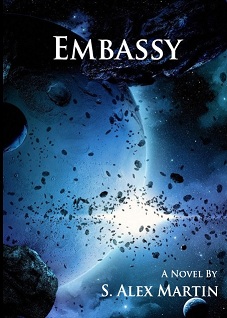
I am 20 years old and I started writing full-length novels in June 2004, right after 6th grade (literally like two days after school got out). I am an Eagle Scout, I love astronomy, nature, tennis, dogs (specifically German Shepherds and English Bulldogs), and the beautiful city of Pittsburgh. I have three self-published novels and two short stories. The second short story became the inspiration for my current novel, Embassy.

Why did you start writing? Did you always want to be a writer?
Christopher Paolini, who wrote Eragon, is the sole reason I picked up a pen and started writing all those years ago. I’ve been writing for close to half of my life. There were times when I took extensive breaks (specifically, June 2004-December 2005; August 2007-May 2008; February 2010-February 2012; April 2012-January 2013). Yes, I keep a record of everything.
There were times where I didn’t see myself being a writer. I also thought it’d be nice to write for a living, but after three novels and no success (and being young, so believing no publishing contract after three novels meant failure) I sorta got in the mindset of wanting to be a high school physics teacher. But January 2013 rolled around, I started writing Embassy, and now I’m determined– with every fiber of my being–to make writing novels my career. I realistically believe that Embassy is going to be my debut novel in the traditional market.

How much research do you usually put into your books?
Umm, it depends. For my first three: next to nothing. For one of my short stories I sorta researched some historical facts as well as space tech. For the other short story (which would later inspire Embassy) I just wrote.
For Embassy itself, I can say that I put some research into it. Things like star names and distances from Earth and relative locations in the galaxy…I’ve kinda mapped-out exactly where Embassy takes place in the Milky Way, because it’s completely possible to do if you take the time.
Also, I had to study the fundamentals of languages, because there is a small bit of foreign language that I had to create from scratch. I have pages and pages of notes about verbs and nouns and conjunctions and participles and negative/positive statements and numbers written out to one thousand. It’s a lot of work just for those two lines of dialogue. But hey, now I speak a language nobody else knows, unless, of course, you are that person who knows what nian am means (yes, I’m looking at you).


What is your writing process? Do you write regularly at certain times or just when inspiration hits?
Go pay a visit to the most disciplined person you know.
Now amplify their discipline by 1000x. That is me. I have chugged through Embassy because I write the moment that time opens up. On a good day, I can write for about 9 hours straight (which I did for 10 days in a row to write Embassy). I write when I wake up. During the middle of the day. At bedtime. Whenever. If I’m not writing, I’m either in class, hanging with friends, or something is severely wrong.
Also, I’m a pantser, which allows me to write on the fly. I just throw stuff on the page. Now that I’ve worked out the plot and really got the story moving, quality and consistency are my top priorities. For anyone who has critiqued or read Embassy, you’ll know that it is pretty solid. I’m in the middle of the fourth draft. I didn’t plot the first or second drafts…but now I have something that works, and beautifully so.

What keeps you motivated?
I don’t let my motivation go away. When I need to get on track, I write and stay as undistracted as possible. I take notes, think, think, think, observe the world, and write. The secret is to keep writing and thinking and observing. Except for when you hit burnout. Then you should take a break. But I write every single day. In Embassy alone, I have written nearly every day since January 5, 2013, and logged 1,673 hours of writing/editing. To put that into perspective, that is nearly equivalent to how much sleep the average person has gotten in that exact same timeframe.
Lesson: I don’t let motivation go away. I lasso it in and tie it to a stake.

What inspired your book? How did it all start?
My first three books were just my imagination running wild. Looking back…it was scary. Somehow I got newspaper interviews and book signings. *shudders at visions of past*
Embassy, on the other hand, could be called the “drainage” of a short story I wrote. That story had two main characters, Arman Lance and Michael Rafting, who were on an assassination mission after being stranded on a planet for seven years.
Long story short (or is it the other way around? Hmmmm…) Embassy is like, the distant cousin to the great aunt whose sister is actually metaphorical for best friend and twice removed from the family tree three generations ago. My point? Embassy is NOTHING like the short story except for four things: General Orcher, Arman Lance, Michael Rafting, and the word “Embassy.” I took the novel in a COMPLETELY different direction than the short story. If you read the short story, you’ll know what I mean. And yes, it is available to readers. Just ask.

If you could only share one piece of advice with aspiring authors, what would it be?
“Walk, talk, breathe, laugh, cry, fall, rise, fail, succeed, run, jump, love, hate, hide, seek, learn, work, play, feel, LIVE.
Then write it down.”

What is your book about? Target age range?
Embassy is about a boy who just wants to be happy. And he doesn’t want to die alone. And he pretty much hates life. And he is trying to forget the bad things that have happened to him. And he obsesses over one girl he hasn’t seen in four years.
Okay, seriously, Embassy follows Arman Lance and his journey to salvage a better life than the one he’s lived. As he travels across the galaxy to find the girl he loves, Arman learns that you should not set your happiness in one person, but find happiness in life and love yourself. He struggles to do this.
It’s a journey, from Arman’s change to the trip across the galaxy. There is love, friendship, struggles, tragedy, adventure, comedy, beautiful vistas, outer space, technology, and a sweet sport called Hologis which some readers have told me is as exciting as Quidditch.
Target age range: Teens and Young Adults. It’s a story both boys and girls can enjoy, too.


What is your goal in writing and publishing this book?
I want to have the fourth draft “completely” done by August 20, 2013. After some minor revisions, I will then begin my rampage of querying agents. I want to go the traditional route.
Also, readers can read “Part 1: The Recruits” for free right now, for a limited time (ending somewhere in September).

Where can we find you online?

From the rest of the admins at YAWA, thank you so much for doing this Alex!
Thank you!